Hire your first employee in Hungary and you immediately take on a duty many founders discover late: you must provide occupational health care. The obligation applies to essentially every employer, regardless of company size — a single employee triggers it. In short: every Hungarian employer must arrange fitness-for-work examinations, keep them documented, and stay current with the legal texts. This explainer lays out the framework, the exam types and the logistics, based on published guides and provider materials reviewed for this article.
The legal backbone, without the jargon
Two core rules define the employer's duty. Act XCIII of 1993 on Labour Safety establishes that employers must ensure occupational health services for their employees. Government Decree 89/1995 (VII. 14.) then regulates how those services are organised, including the classification of jobs into occupational health categories — commonly labelled A through D — and statutory reference fees where no service agreement exists. Detailed fitness-examination rules sit in further ministerial decrees, including 33/1998 EüM. A plain-language guide to occupational health exams in Hungary draws two practical consequences from this framework: employing only medically fit workers is the employer's responsibility, not the employee's, and labour-safety authorities can review examination documentation during inspections, with fines possible when records are missing.
Because fee schedules and enforcement practice change, employers should verify current texts on the official legislation database, njt.hu, rather than rely on any summary — this one included. A second employer-facing overview of the same obligations repeats that caution almost word for word, which is itself telling: the framework is stable, but its details are amended from time to time.
Three exam types drive the calendar
Hungarian practice distinguishes three fitness-for-work examinations. The preliminary exam (előzetes) happens before employment begins, confirming the candidate is fit for the specific role. The periodic exam (időszakos) repeats at intervals set by the job's occupational health category and the physician's risk-based assessment — low-risk office roles follow a longer cycle than physically demanding or hazardous work. The extraordinary exam (soronkívüli) is triggered by events: a long sick leave, a workplace accident or a significant change in duties. A Hungarian-language employer guide to üzemorvosi vizsgálatok stresses the division of labour here: the occupational physician, not the employer, sets the medical frequency — but the employer carries the administrative duty to make sure it happens on time.
Special rules add to the schedule. Employees who spend at least four hours a day at a display screen require an eye examination every two years under the applicable regulation — a detail office-heavy employers frequently miss, as a second Hungarian employer guide points out.
What actually happens in the examination room
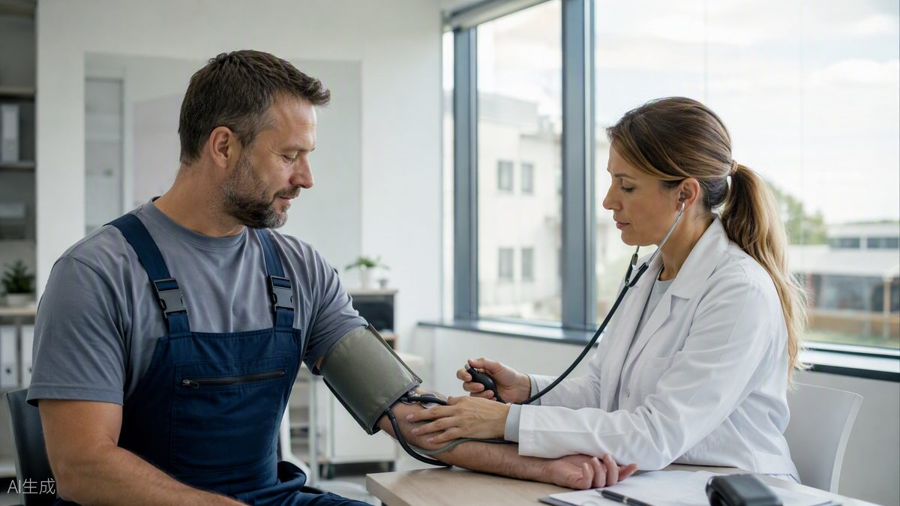
According to published descriptions from Ameamed, a Budapest-based occupational health provider used as a reference point in several of the reviewed sources, a standard occupational exam takes roughly 8 to 10 minutes per person. It covers medical history, an internal-medicine palpation examination, blood pressure and pulse measurement, and vision testing of acuity and colour vision. The result is a fitness judgment for the specific job — not a general health check and not a diagnosis. Certain regulated occupations such as food handling, hospitality and childcare require a separate certificate, the egészségügyi kiskönyv or "health book", with its own rules including a recent negative chest X-ray. A third Hungarian summary of the employer rules makes clear the two documents should not be confused.
Logistics and language: the underrated details
Hungarian rules prefer examinations delivered at or near the workplace, so providers offer on-site exams at company premises. Ameamed, per its website, conducts on-site examinations with free travel within Budapest above a minimum headcount, runs clinics in Budapest's XI. and XIII. districts, and operates a nationwide network covering cities including Debrecen, Szeged, Pécs and Miskolc. For employers with international staff, English-language questionnaires are available — a practical detail given Hungary's growing foreign workforce. A Hungarian analysis of occupational health from compliance to wellbeing adds a useful distinction: keep the compliance book and the wellbeing book separate, because a generous screening programme never substitutes for the mandatory exams. Employers weighing voluntary extras such as executive screening can consult a separate Q&A on executive screening in occupational health, which explains why those packages are benefits, not legal obligations.
On pricing, providers publish "from" per-person rates; treat them as entry points and confirm figures directly before budgeting, since published starting prices can differ between pages.
A six-point routine that survives inspection
Map every role to its occupational health category and exam frequency. Schedule preliminary exams before day one, not after. Track periodic deadlines centrally — a spreadsheet works if someone owns it. Diarise the two-yearly screen-work eye exam for qualifying roles. Keep documentation inspection-ready, because authorities review records, not intentions. And if you employ non-Hungarian speakers, arrange language support in advance. This article is general information, not legal advice; verify obligations against the current texts of the 1993 Act and Decree 89/1995 on njt.hu, or consult an occupational health provider about your specific situation. Employers who treat the exam calendar as routine administration rarely have problems with it.